
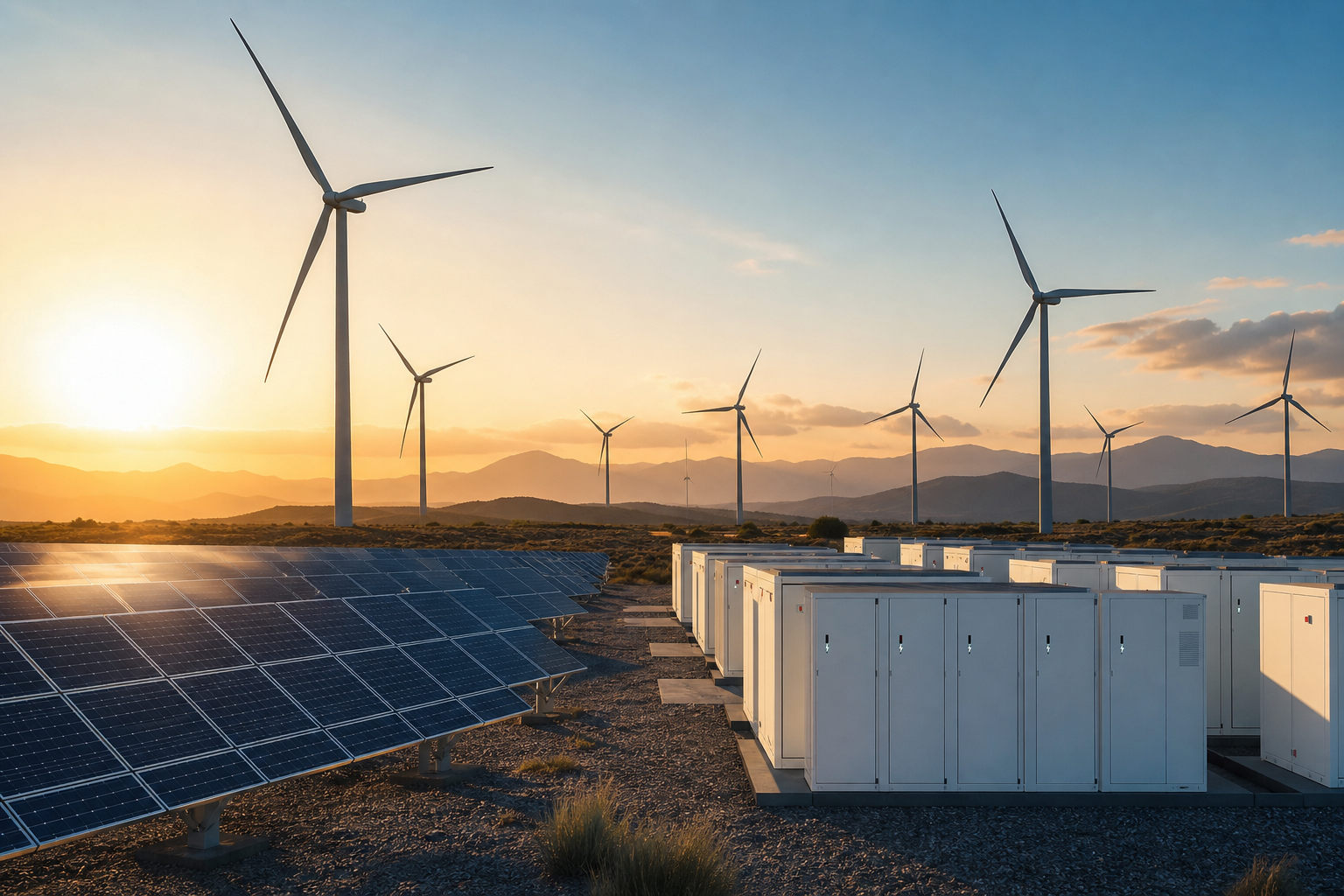
The Turkish energy sector is undergoing a critical transformation process to increase security of supply and balance the variability of renewable energy sources on the grid. The storage-integrated electricity generation regulations published by the EPDK (Enerji Piyasası Düzenleme Kurumu - Energy Market Regulatory Authority) have opened the doors to a new era for investors. It is no longer enough to simply produce solar or wind energy; when, how much, and with what price margin this energy is supplied to the grid have become the fundamental elements determining project profitability. Hybrid power plants (Solar+Wind) and Battery Energy Storage Systems (BESS) stand out as the most powerful solutions for utilizing idle capacity and ensuring uninterrupted energy supply.
Strategic Importance of Hybrid Plant and Storage Integration
In traditional power plant models, fluctuations inherent to the nature of the production source increase balancing costs for grid operators. Hybrid power plant design aims to minimize these fluctuations by utilizing the complementary production profiles of wind and solar, in particular. Feeding the wind blowing at night and the sun shining during the day into the system from the same Point of Connection (POC) ensures that existing transformer and line capacity is used with nearly 100% efficiency.
Efficient Use of Connection Capacity
Capacity allocations in Turkey's existing transmission and distribution grid are quite limited. Storage-integrated GES (Güneş Enerjisi Santrali - Solar Power Plant) projects allow investors to add more installed power without exceeding their existing capacity allocations. For example, a facility with a 10 MW connection capacity can use a storage unit to hold excess energy produced during the day and feed it into the grid during hours when the sun sets or demand (and price) increases, thereby overcoming capacity constraints.
Design and Engineering Criteria in Battery Storage Systems
The most important technical parameter to consider when designing a storage-integrated power plant is the charge and discharge rate, known as the "C-rate." The battery chemistry and capacity should be selected according to the purpose of the plant (frequency control or energy shifting?). Lithium Iron Phosphate (LFP) batteries are currently the most preferred technology in the sector due to their safety and long cycle life.
- Cycle Life: How many times the battery can be fully charged/discharged directly affects the Return on Investment (ROI).
- Round-Trip Efficiency: How much of the charged energy can be recovered is critical for managing energy losses.
- Thermal Management: Optimizing the internal temperature of battery containers is vital for both safety and performance continuity.
Smart Charging and Discharging Strategies
The success of hybrid and storage systems depends not only on the hardware but also on the software intelligence managing it. Smart Energy Management Systems (EMS) determine the most profitable operating mode by analyzing market prices such as PTF (Piyasa Takas Fiyatı - Market Clearing Price) and SMF (Sistem Marjinal Fiyatı - System Marginal Price), weather forecasts, and grid needs.
Arbitrage and Balancing Power Market (DGP) Management
Charging the battery when prices are low and discharging during peak hours (arbitrage) is one of the primary revenue streams for storage systems. However, a more sophisticated approach is to make the plant an active player in the DGP (Dengeleme Güç Piyasası - Balancing Power Market). An operation that instantly corrects deviations in demand forecasting with the battery can reduce imbalance costs by 30% to 50%.
Case Study: 50 MW Wind + 20 MW Solar + 10 MWh Storage
Suppose 20 MW of solar panels and 10 MWh of battery are added to a wind farm. While wind production is high in winter, transformer capacity is used to its full limit with solar support. In the summer, solar panels kick in during hours when the wind decreases. The battery unit stores the excess production between 12:00-14:00, when the sun is at its peak, and feeds it to the grid during the highest price period between 18:00-21:00. In this scenario, the facility's total annual energy production increases by 25%, while revenue per unit of energy rises by 15% thanks to time-shifting.
Monitoring and Performance Tracking: The SmartPlain Approach
Data complexity is a major problem in hybrid plants with many different components (inverters, battery management systems - BMS, meteorological stations). Real-time monitoring of performance ensures that potential failures (e.g., overheating in a battery cell or a production drop in a string) are detected in advance.
AI-powered platforms like WorkyBe SmartPlain make sense of this complex data to provide operators with action-oriented insights. The economic life of the facility is maximized through Performance Ratio (PR) tracking, degradation analysis, and predictive maintenance models.
Carbon Border Adjustment Mechanism (CBAM) and CSRD Impact
The importance of green energy production is increasing not only for the local market but also for exporting industrialists. Under the European Union's CBAM (Carbon Border Adjustment Mechanism) regulation, energy used in production processes must be "green" and "traceable." Storage-integrated hybrid plants are becoming strategic partners for industrialists with their potential to provide 24/7 continuous green energy certification (such as I-REC).
Frequently Asked Questions (FAQ)
What is the payback period for storage-integrated PV investments?
While the payback period varies based on technology costs, grid connection fees, and electricity price forecasts, it is generally estimated to be between 6 and 9 years under current incentives and market conditions.
Can an existing PV project be retrofitted with storage?
Yes, battery storage systems can be integrated into existing plants using AC or DC coupling methods. However, this process requires technical inspections such as inverter compatibility and the suitability of physical space at the substation.
Which source is considered the "main source" in hybrid plants?
According to EPDK regulations, the source that was first connected to the system and specified in the license is the main source. Other sources (e.g., a solar plant installed next to a wind plant) are defined as auxiliary sources, but all energy produced is supplied through the same connection point.
What is the best strategy to extend battery life?
Keeping the battery's Depth of Discharge (DoD) at 80-90% levels, keeping cell temperatures under control, and avoiding unnecessary fast charge/discharge cycles optimizes battery life. All these processes should be managed by smart EMS software.