
The Turkish Electricity Transmission Company (TEİAŞ) has published the unlicensed electricity generation capacity allocation results for the 1 December 2025 – 30 April 2026 period. Of 190 total applications, 82 received positive opinions; the new capacity to be connected to the transmission system reached 1,447.8 MW.
The numbers alone are an announcement; but between the lines lie much more critical signals for the unlicensed SPP investor. Which regulation article is prominent, which transmission region is congested, and how does this table overlap with the hourly settlement era? A short and clear analysis below.
Application and Approval Rate: Approximately 43%
Of 190 projects evaluated during the 5-month application period, 82 received connection opinions. This means a ~43% approval rate — numerically confirming the "grid saturation" pressure observed in the sector in recent years. Most of the 108 unapproved applications can be assessed as postponed due to regional capacity shortages.
Distribution by Regulation Article
The overwhelming majority of projects receiving connection opinions fall under Article 5.1.h of the Unlicensed Electricity Generation Regulation — meaning self-consumption focused projects where the producer and consumer are the same legal entity.
| Article | Project Count | Total Installed Capacity | Profile |
|---|---|---|---|
| 5.1.h | 42 | 1,325.21 MW | Self-consumption / net metering |
| 5.1.ç | 36 | 116.87 MW | Rooftop/facade applications |
| 5.1.c | 4 | 5.80 MW | Renewable source |
| Total | 82 | 1,447.88 MW | — |
The clear meaning of the table: the unlicensed SPP market no longer moves with the goal of "sell and earn money" but with the goal of on-site net metering of consumption. The concentration of 1,325 MW under a single article is not coincidence — industrial consumers and industrial groups have already moved to a portfolio strategy.
Generation–Consumption Point Location
TEİAŞ announced the connection opinions in three classes based on the location relationship of consumption and generation points:
| Location Relationship | Projects | Capacity |
|---|---|---|
| Same location | 51 | 328.72 MW |
| Same region | 20 | 770.45 MW |
| Different region | 11 | 348.71 MW |
The authority allocated by far the largest capacity (770 MW) to projects with generation and consumption points in the same region. This shows the regulator's clear guidance: consume the energy you generate as close as possible.
Regional Capacity Status: 9 of 15 Regions Full
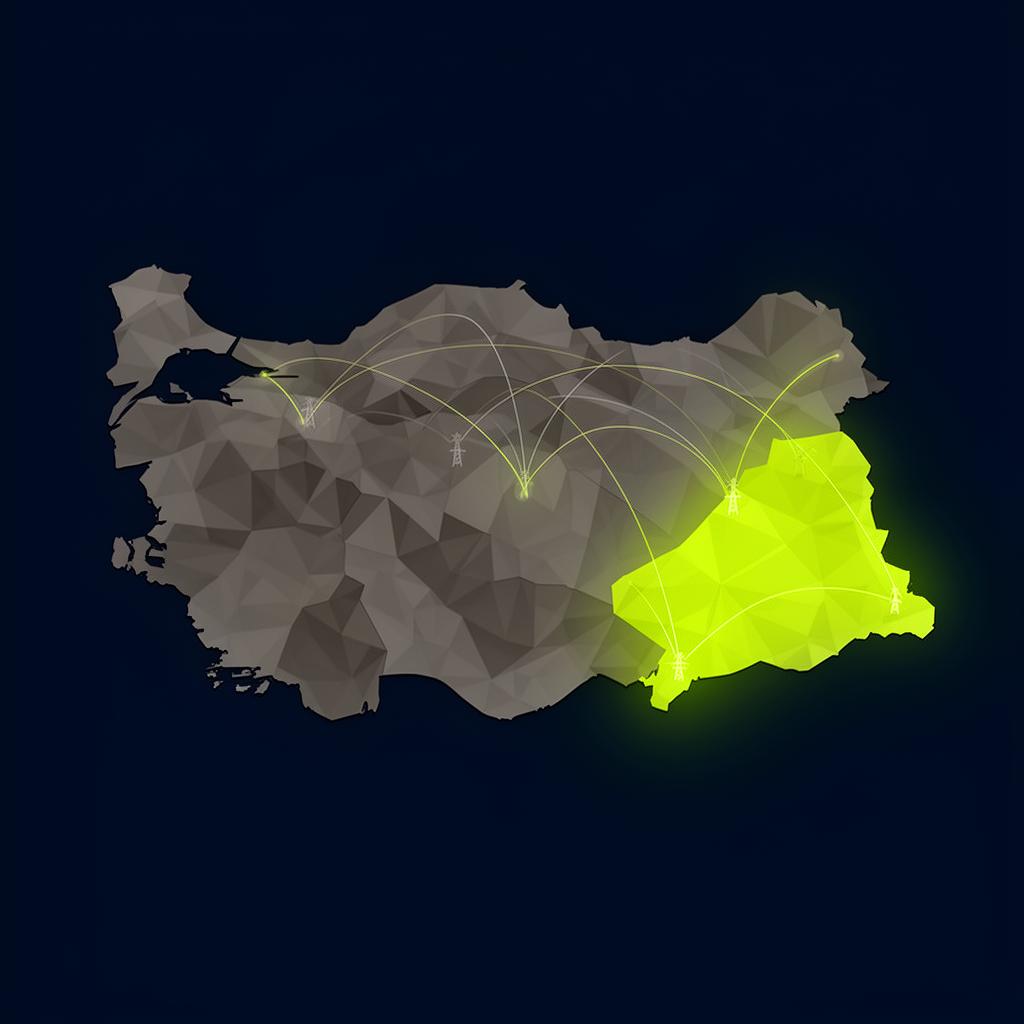
In 9 of the transmission grid's 15 regions no capacity remains for new applications. Only 46.6 MW of free capacity remains in the remaining 6 regions:
- Region No. 11: 14.1 MW
- Region No. 12: 13.8 MW
- Region No. 1: 8.1 MW
- Region No. 9: 5.6 MW
- Region No. 3: 5.0 MW
These numbers show that for companies planning a new unlicensed SPP investment, site selection has now become the main decision variable. Positioning the consumption facility in the correct region directly determines whether the project will materialize.
SmartPlain Perspective: What Does This Table Mean?
The approval of 1,325 MW under 5.1.h is not just a bureaucratic detail — it's an operational revolution signal. Because self-consumption focused projects, when combined with the hourly settlement regime, become entirely dependent on data and automation quality:
- Generation profile monitoring: Without real-time and historical generation data, it cannot be calculated in which hours there is surplus/deficit generation. SmartPlain automatically collects this data from all major inverter brands.
- Consumption matching: Net metering gain depends on the generation aligning hourly with the consumption profile. We detailed the financial impact of this topic in our hourly settlement guide.
- Regional restrictions: In an environment where grid saturation is increasing, extracting every last drop of efficiency from the existing plant is a lower-cost growth path than adding new capacity.
- Etta integration: Seeing hourly energy data of the consumer side together with generation data on the same interface dramatically reduces settlement losses compared to manual Excel tracking (example calculation).
Practical Takeaways for Investors
- Site selection is now the beginning, not the end, of feasibility. In a grid where 9 regions are congested, separating consumption and generation points creates profit-loss differences.
- The 5.1.h weight has made the "generate-consume" business model standard. Generation that cannot be matched hourly is lost revenue.
- Optimizing the existing portfolio provides faster returns than adding new capacity. Real-time monitoring + fault early warning + hourly settlement tracking are the minimum requirements.
- Preparation for the next application window starts now. The retrospective 12-month profile of consumption data is becoming an increasingly strong argument in connection opinion applications.
The unlicensed SPP market is maturing; the competition is shifting from "who builds" to "who operates more efficiently". SmartPlain was built exactly for this transformation — plant monitoring, automatic provider integration, hourly generation-consumption matching, and settlement tracking in one interface.
Sources: TEİAŞ Unlicensed Generation Announcement (26 May 2026). For detail on the EPDK unlicensed generator-2 tariff see our EPDK 2026 Tariff Decision article.